The Eastern Shore of Nova Scotia runs from Halifax Harbour all the way to the Strait of Canso, where the province splits into Cape Breton Island. This underappreciated coastline has a geography different from the opposite coast of Nova Scotia, with more small fishing villages, rocky outcroppings, and some of the most well known beaches in the province.
In 2020, the pandemic had just started. The law school I was attending sent us all home, and I went back to rural Nova Scotia. I got a job in the middle of absolutely nowhere, and was told housing would be ‘challenging’.
That was the understatement of the century.
There was absolutely nowhere to live.
As has become a common refrain in the months and years since the pandemic started, housing is at a premium, and finding a place to rent (let alone one that is in a convenient location and isn’t gross) is a major difficulty for thousands of people. The housing crisis has only gotten worse since May of 2020 when I was looking for a place to live, but at the time, in rural Atlantic Canada, it was still a rough go. There were no rentals.
Let’s buy a house!
So I started to look at houses to buy. I was in a beautiful part of the province, and I (and the rest of Canada apparently) had decided to buy property. I would go out to tour houses (not that there were many in my very low budget) and realtors would tell me they were selling everything they had to people from Ontario and Alberta. Nova Scotia was closed to visitors, so these folks were buying houses without ever setting foot inside them – nor within the boundaries of the province.
After making a lowball offer on a house and being rejected (twice), it was seeming more than a little futile that I’d ever find a place. I was living in AirBnBs that were costing way more than I was making in income and the whole situation seemed poorly thought out (and it probably was!).
A colleague turned me on to a private sale that was posted on social media. The house had a tiny ‘for sale’ sign out front, and was occupied by tenants. I went to see it on a whim and felt confident I wouldn’t be buying it, so didn’t spend much time absorbing its features.
Several weeks later, having still found nowhere to live, I called back the people with the private sale. They were asking $90,000 for the house, which came with a shed of sorts and half an acre of land. I debated offering a lower amount, but honestly didn’t have time to negotiate. What I needed was unoccupied possession of the property within mere weeks – not the month or two most deals come with.
They agreed. We had a house deal!
The house on the day I visited and didn’t think much about it
What were the costs to buy?
I did not want to pay for mortgage insurance from CMHC (Canada Mortgage and Housing Corporation). They require that you have insurance if your down payment is less than 20% of the purchase price.
On a $90,000 house, a 20% down payment was $18,000. The property deal required a deposit of $1000, which was eventually applied to the purchase price. I also had to pay for a home inspection, which came in at $488.75. The cost for a lawyer to review the deal was a little more than $600. Because it was a private sale, and neither myself nor the seller had a realtor, we did not need to pay realtor fees (which are usually about 5% of the purchase price).
That left me with a mortgage of $72,000, which worked out to $150.36 every two weeks.
Although I had to pay lots of expenses up front (the lawyer, the deposit, the down payment, and the inspection), paying about $300 a month in living expenses was nothing compared to the $1300 or more in rent that was common in major centres.
So, how did you go from your $90,000 purchase, to a $210,000 winfall?
My initial investment was $90,000, plus taxes and fees which brought me to $92,192.71 plus the services listed above. Two years later almost to the day I sold that same house for $210,000.
First things first – the market helped. I bought the house at a time when yes, the market was definitely hot, and it wasn’t a good time to be a buyer, but it was a funny house in a funny location so I got in at a good spot. In the two years that followed (spring 2020 – summer 2022) the market across Canada went wild. Houses were selling well above asking, interest rates were super low, and people were buying like mad. I didn’t sell at the peak of that hot market, but I didn’t totally miss the moment either. So that’s just luck.
Beyond that, when I moved into the house it was a bit of a mess. It had been home to several rounds of tenants, so hadn’t been cared for the way an owner-occupier would. Some critical things needed doing straight away – the front window was cracked, other windows needed replacing, and the appliances were struggling.
The house was a 1970s bungalow, with two small bedrooms on the main level, and three additional bedrooms in the basement, plus a storage area and sitting room downstairs. Originally, there were two bathrooms on the main level – one off the living space, and one off of a bedroom (sort of like an en suite but that might be generous). The main bathroom was tiny – you could walk in a small circle but that’s it – and had the largest bathtub I’ve ever seen. It was also entirely walled in unfinished wood paneling!
The bathroom, pre-renovation!
Renovations: The House Flip
It was clear from the first day I moved in that some work needed to be done. The window, obviously, and the kitchen was a bit of a mess. I started tearing out cabinets that had obviously been added ad hoc by a supposedly handy occupant of the house. The previous tenant had been the proud owner of some kind of bird which had left its mark over… everything, so that was a fun surprise. And then there was the entry to the main living space, which in two square feet had not two, not three, but four doors – some of them at angles to each other.
Doors on doors…
It was the peak of construction season though, and there was no way a contractor was going to do any work on my house until the fall. I worked on some of the easier fixes – tidying up the garden, tearing down the old shed at the back of the property, and replacing the appliances.
Attacking the old shed
At the end of the day, another $63,000 was put into the house to make it livable. I wasn’t planning to flip it or sell it – I had a job and wanted to live in the house for the long term. I made choices about appliances, fixtures, and fundamentals like lighting based on my desire to like where I lived.
The old kitchen (after removing some cabinets above the fridge)
Had I been flipping the house with the intention to just resell, or to have tenants, I likely would have made different decisions. There could have been small savings on things like appliances, or fixtures. But big things still needed to be done. About $10,000 had to go into electrical work off the bat to deal with old fuse boxes, upgrading panels and wiring, and adding pot lights throughout the space. Luckily, I didn’t need to touch the basement except a coat of paint we had lying around, and the main level was only 900 square feet, so individual costs for things like flooring and paint could be kept low.
Starting demolition
The whole renovation took far too long. Electrical work was started in the fall. Nova Scotia has an efficiency program to help homeowners make upgrades to insulation and other features that improve energy efficiency, so I was able to take advantage of some of those and receive a rebate on windows and doors, and free insulation in the attic of the house. True construction took several months, and it was not until about March of 2021 that the workers were essentially gone, and the house was liveable. But what a change!
New kitchen cabinets and colour – but kept the best dishwasher ever! No more wood panelling in the bathroomNew flooring (bought on sale) and paint throughout
We converted the second bath (the ‘en suite’) to a full laundry space with stackable washer-dryer. This wouldn’t have been everyone’s choice, but having the laundry upstairs and out of the basement made it way more pleasant, and the whole house became fully accessible on one level which was a bonus.
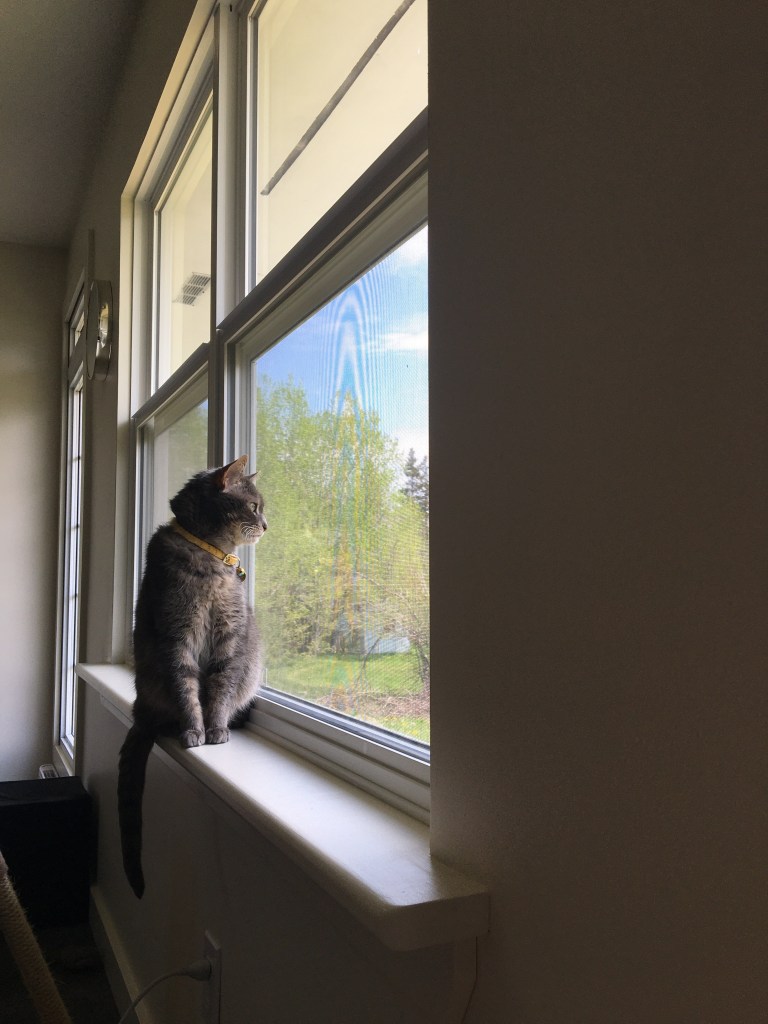
We made sure to keep the nice window sill that the cat liked so muchCompleted main living space
By summer, a new deck was added and the landscaping was finished. The property already had several apple trees which bloomed in spring so it didn’t need too much additional work.
Becoming a Landlord
The following year, my job changed, so I got tenants in the house. Read more about becoming a landlord here. At $950 a month, I was bringing in three times the monthly mortgage payment and earned $10,450 in the course of the 11 months that I rented out the property, with only $3300 in mortgage costs in that same time. I also paid property taxes, which were relatively low in rural Nova Scotia – about $500 for the year.
Then in the spring of 2022, the market still going strong, I decided to list the house for sale. It didn’t really bother me if it didn’t sell; I was happy to have tenants, and the area needed rental properties. But the market was going to cool eventually, and if I could get my money back out of the house, this would be the moment!
At the end of the day, I managed to sell it for $210,000. After paying out the remaining mortgage ($68,000) and the fees for realtors (5%), lawyers, and all the rest, I took home $130,726.16 from the sale. That, minus the $63,000 that was put in for renovations, and I pocketed about $67,700 in profit.
Of course, two caveats should be mentioned.
One – there were other expenses. Things broke while the tenants lived in the house; $1300 went out the door to replace the water tank. The lawn needed to be mowed, and the snow shoveled. Stuff costs money. It was also hugely time consuming for me and my family to get this done. The labour cost for us alone would be wild. This was not a small project, and I had to live in the house throughout the renovation which was very little fun.
Two – I never set out to buy, renovate, lease out, and then sell this house. Had I planned to do that, some things could probably have cost less (though others could have been more!). Living rurally, during an international health crisis and an supply chain problem, added to certain costs for materials. The pandemic complicated getting supplies, getting workers, and just generally getting the job done. This was by no means a smooth, well thought through plan. It just happened to work out. I got lucky.
Certain things worked really well though. I chose modern fixtures, stainless steel appliances, and funky colour schemes for the house. This made it stand out when I eventually went to list it.
The layout of the house made it really easy to keep clean for both me and the tenants, which meant it showed well when it was listed.
I really wanted a pantry, so used a sliding barn door to increase storage in the hallway
Nothing was so fancy or expensive, but having high quality lighting and good storage made a big difference in a small space. A simple Home Hardware kitchen was not a high priced item, but made such a huge impact.
All in all, a $67,000 take home after living in the house for a year, renting it out, and renovating it is a pretty good deal since I didn’t mean to do any of it in the first place.
About an hour’s drive from Halifax you’ll find Hants County, a sleepy, under-appreciated part of Nova Scotia and as a result, very low on tourists. A secret, hidden gem! Nearly empty campsites, roads free of traffic, and you won’t have to edit out any extra people from your Instagram photos.
One of the easiest ways to keep your money in your pocket on travel days is to pack your own snacks. Of course, with security restrictions around liquids and gels this can get a bit tricky. And if you’re flying with only carry on, you don’t want a bag full of tupperware containers with no room for socks. But these five vegetarian foods travel well, you won’t risk food poisoning by leaving them unrefrigerated, and will give a hit of nutrients and energy for those long travel days.
24 hours is nowhere near enough to cover everything the Avalon Peninsula in Newfoundland and Labrador has to offer. But anything is better than nothing! Here’s how to spend 24 hours in St. John’s, Newfoundland.
On the Battery walk
That being said, 24 hours is enough to eat some really good food, see some picture perfect views, do a little hiking, see a little live music… do it all really – just fast.
St. John’s is the capital city of Newfoundland and Labrador. In recent years, it’s become a hot spot for serious chefs doing nifty things with local food, a hub of arts, theatre, and music, and a jumping off point for hiking around the East Coast Trail.
Weather-wise, July to September gives you the best chance of getting a bunch of sunny days in a row. We got lucky with a week in June this year that had the best weather I’ve ever seen on the island. The rest of the year is hit or miss, and November to March can be particularly dreary – cold, wet, windy, and icy. But! Traveling in the off season will still yield the great views and good food, with fewer tourists and more available rental cars. There’s really no bad time to visit.
Have a drink on one of the many patios on the pedestrian mall on Water Street
The Highlight Package for 24 Hours in St. John’s
See in St. John’s:
The Rooms is the most prominent museum and gallery in the city. Built on one of the many hills in St John’s, the design of the building is worth a look – and you can enter and wander without paying if you’re traveling on a budget. You’ll learn some Newfoundland history, and usually there is at least one significant art exhibit showing, plus a film in one of the theatres. Stop for a coffee in the very scenic cafe and get a nice view of the Narrows from the large windows.
Walk or drive up Signal Hill to get a view of the whole city and check out Cabot Tower. If you can, head up at sunrise or sunset to get Instagram-worthy photos. Watch out for wee fox friends who like to hang out on the hill. If you have time, and are feeling ambitious, hike up the North Head Trail through the Battery neighbourhood up to the top of Signal Hill (Parks Canada calls this trail ‘strenuous’ – it’s a serious commitment).
Cabot Tower on Signal Hill
Head out to Cape Spear Lighthouse National Historic Site for more views of the rocky shoreline. Keep an eye out for seabirds and other nautical creatures.
If you have time left over, try to get to Petty Harbour, home of Great Big Sea lead singer Alan Doyle. Or, stick closer to town and wander the trails at Bowering Park.
Eat in St. John’s:
The restaurant scene in St. John’s shifts frequently, and COVID has messed with the market a little. But there is never a shortage of good things to eat.
Try Bannerman Brewing Co. for coffee, beer, and an eclectic menu of small plates. I recommend the mushroom fried rice.
The Parlour Gelato + Coffee
The Merchant Tavern on Water Street serves higher end fare, all freshly picked, fished, and foraged. Try anything with pasta, and sit out on the patio if you’re able.
Fish and chips with dressing (i.e. stuffing with savoury, like you’d get with turkey dinner) and gravy is the stuff dreams are made of. You can get fish and chips anywhere you go on the island. But the best (I think) is at the Duke of Duckworth, tucked down an alley off Duckworth Street.
Don’t forget to pick up an americano and an almond croissant at The Rocket on Water. Or, grab a gelato in a waffle cone at The Parlour Gelato + Coffee on Military Road before you head off on your next adventure!
Water Street, St. John’s
Play in St. John’s:
If there’s something on, take in a show at the LSPU Hall in downtown St. John’s. Often small theatre groups or members from the university music school will have performances. But professional theatre productions also take centre stage at LSPU. If you’ve only got a short time on the island, you’ll get a little taste of the arts and theatre scene here.
Feeling like an adventure? Zip lining over Petty Harbour should get your heart rate up. Having not personally wanted to fling myself over a harbour, I cannot speak to the thrill of this one! Book in advance so as not to be disappointed.
Views from Signal Hill
After supper, stop for live music at one of the many venues in town. Check out The Ship Inn, Green Sleeves, O’Reilly’s, or the Arts and Culture Centre for traditional (and less traditional) music.
We’re already 6 months into the year and my Goodreads account tells me I’m 8 books behind. Off to a great start. If you’re new to Goodreads, they have a reading challenge each year. Participants can choose how many books they’d like to get through in 12 months. I try to set relatively high goals but clearly this year I’m not winning yet.
I’ve had a very mixed bag of reads this winter/spring. You can find all my 2022 choices here.
Best of the bunch
Go, Went, Gone by Jenny Erpenbeck – 5 stars
This was by far the best book I’ve read all year, perhaps even beating out last year’s reads. Erpenbeck is a German author. The story follows an older German man who becomes embroiled in the refugee crisis as it spills into Germany. He gradually befriends African refugees. The sparse and poetic prose delves into the international refugee crisis in a human and touching way. Richard learns more about the men he comes to think of as friends. He discovers the inequities and barriers that the German and other European governments put in their way. Incredibly sad if you already have empathy for refugees around the world. Incredibly timely and pointed if you don’t.
Best for: The family member who doesn’t understand refugee issues
Second best of the bunch
Misconduct of the Heart by Cordelia Strube – 5 stars
Similar to Go, Went, Gone there’s a definite refugee/asylum seeking theme running through this one. Also a cranky protagonist, child welfare and PTSD plot lines, and a Canadian city as a setting! What more could you want? Not exactly cheerful reading, but dry and witty.
Best for: A fiction-lover who doesn’t mind a bit of angst.
Most Inspirational
Meet the Frugalwoods: Achieving Financial Independence Through Frugal Living by Elizabeth Willard Thames – 5 stars
Not a complicated premise – own less stuff, buy less stuff, save money. This was an oddly inspirational memoir of a family who did exactly that and got the life they wanted. They ended up living in the woods which is not quite what I’d be looking for. But it was a good reminder that owning less and buying less saves money and stress in the long run.
Best for: The “Shopping is my entertainment” friend or family member.
Best Young Adult Novel
Counting by 7s by Holly Goldberg Sloan – 5 stars
This was such a cute, quirky little novel. It starts out with a tragic bang but really does get better. It also has an immigration theme going on and some really lovely interactions between funny characters. Reminiscent of Misconduct of the Heart but for young adults, I -not a young adult- really liked it.
Best for: The mature young reader who likes people and their foibles (and perhaps gardening).
Biggest Let Down
The Dazzling Truth by Helen Cullen – 1 star
I really wanted to like this one. I’d seen it on social media receiving great reviews. Set in Ireland, with an artsy theme … seemed like a good bet. But both the plot and the writing was simplistic and predictable. I raced through it, but not in a good way. It was a feel-good story. It would have made a good beach read but wasn’t the hard-hitter I was hoping for.
Best for: Someone looking to lie on a beach and not work that hard.
Now, I’m working through The Strangers by Canadian Katherena Vermette. This is a sequel to The Break which came out a few years ago. It follows a fictional Metis family in Canada, and the inter-generational trauma and challenges that affect their futures. It’s heavy subject matter even for those of us familiar with it, and I’m moving through it slowly.
What’s next on your reading list? Did you have a favourite title from the first half of the year?
Many tourists book their tickets to St. John’s or Deer Lake or Gander, and then announce that they’ve set aside a week to “see Newfoundland.” Newfoundland is physically a very large province. If you drove from one side to the other, without stopping, you could be driving for about 12 hours. And that wouldn’t be much fun because there is loads to see in the middle of the province, making it tempting to stop frequently – and so you should!
That being said, there are plenty of things to do and see in seven days. If you divide up the province, they can even be done well. This itinerary will cover the easternmost side of Newfoundland. You’ll get a taste for the cosmopolitan city life, as well as the small-town, quaint bits.
St. John’s
Fly into St. John’s International Airport, located about 20 minutes from downtown. If you’re lucky, the pilot will take you the scenic route, coming in over the ocean and the cliffs. Spend at least three nights in the city to have enough time, particularly if you want to hike. Take in various outdoor activities, including Signal Hill (from the Battery walk, and via the road) and Quidi Vidi Lake. Watch the sunrise from Cape Spear, the easternmost point in Canada. In the fall, take in the leaves at Rennie’s River Trail and Bowering Park.
Looking toward the Narrows from The Rooms
Have brunch at one of the many restaurants on on Water Street. Either traditional fish and chips or higher end fare is available. The chip truck – Ziggy’s – parked near Atlantic Place is always a good choice. Pick up souvenirs and local goods in the independent shops on Duckworth Street. Take in a show at LSPU Hall or at the Arts and Culture Centre.
Dinner at any of the other many restaurants downtown will leave you satisfied with local flavours and products. many of which are sourced directly from the producers, farmers, and fishers. Post-pandemic, many restaurants have changed hands and started fresh. But there is no shortage of options, from local cuisine to international dishes.
Visit The Rooms museum for Newfoundland history and ideal views of the Narrows. The Craft Council on Duckworth has locally, and lovingly, made arts and crafts. Visit one of the many historical churches in downtown St. John’s. Get your picture taken in front of the jellybean row houses. Up from Duckworth, away from the harbour, Gower Street, King’s Road, etc. And if boats agree with you (they don’t with me) by all means head down to the harbour. Take one of the highly thought-of tours to see icebergs, whales, and various other oceanic sights. Let me know how it is. I’ll be on land with a coffee or a drink (at The Rocket or Bannerman Brewing).
Restaurants and shops on Water Street
Spend a day touring the Avalon Peninsula. From St. John’s, you are minutes from Middle Cove, Outer Cove, and Topsail Beach. Various East Coast Trail starting points dot the peninsula and even without a car the taxis and day tours will take you to the highlights.
Trinity
Trinity, Newfoundland and Labrador
Drive less than three hours from the city to reach Trinity, a small village on the water full of historical buildings. You’ll want at least two nights, to accommodate both day trips and the various activities in town. The main highlight of Trinity is Rising Tide Theatre Festival, a summer festival of Newfoundland classics and historical pieces, featuring a majority of Newfoundland actors. Spend a day at the Festival to take in the Pageant – a roving theatrical production outlining the history of Trinity and the surrounding area – the dinner theatre, and a main stage production in the evening. If you wish to meet the actors, or locals, they can most likely be found at the pub – you’ll find it. Trinity Coffee Company is roasting small batch coffee in a very small town, and you’ll want to pick one up before heading off on the Skerwink Trail, near Port Rexton, an award-winning hike with spectacular views of the ocean, cliffs, wildlife and sea stacks.
Accommodations in and around Trinity are lovely, and limited – so book early, particularly if you’re traveling in August and September. Stay right in Trinity at the Artisan Inn, or at Fisher’s Loft in Port Rexton, just a few minutes down the road from town.
Port Union
Just under 30 minutes from Trinity, this historical town plays an interesting and important role in Newfoundland’s past, and the Fisherman’s Protective Union. The entire town appears locked in the early 1900’s. Tour the Port Union factory building and see the printing press, as well as archived pieces and historical tools and household items in the museum. The surrounding area is picturesque and worth visiting once you have explored the town itself.
Elliston
Another 20 minutes or so from Port Union is Elliston – home of the puffins. One of the highlights of Newfoundland is wildlife. If you didn’t get a chance to see any puffins on your boat tour in St. John’s or Trinity, don’t miss a stop at Elliston. Bring your own binoculars, or, once you’ve parked your car on the side of the road, borrow a pair. You will be able to see the puffins – birds smaller than you might imagine – on the adjacent rock. Bring a blanket, or sit in the grass and enjoy the view. Stay all day if you wish – it’s not remotely corporate, and no one will ask you to leave.
Bonavista
Bonavista is day-tripping distance from Trinity (less than an hour by car), or another spot worth spending a night, depending on your schedule. First on the agenda is a tour of the Matthew, a replica of John Cabot’s ship, appropriately located at his first landing place. From Cape Bonavista Lighthouse Provincial Historic Site, you may be able to spot an iceberg, and you’ll get a taste of Newfoundland history in the quaint downtown.
Take in the cliffs, the fishing boats, and the rugged coastline, before heading twenty minutes down the coast in the direction of Newman’s Cove to Bonavista Social Club at Amherst’s Cove for lunch (open during the summer, only). The self-sufficient restaurant produces and grows their own products for breads, soups, salads, and pizzas. You could even do the loop in one day from Trinity, to Port Union, Elliston, Bonavista, and back to Trinity in time for dinner.
Even more?
If you manage to cover this segment of Newfoundland in a week, you’ll have been very successful (and potentially overwhelmed). But, if you still want more, carry on west to Gander (now famous for its starring role in the Broadway musical Come From Away), Fogo Island, Twillingate, and Terra Nova National Park. I would recommend taking as much time as you possibly can free up to see as much of the province as possible. Nothing you see will be remotely close to mediocre, and may even make you question your eyesight. Seeing that many cool things in a week can have that effect.
Everyone has things they want to do. You know, the wish list that comes to you in the middle of making dinner, or between drafting emails at work – I want to speak Italian; I wish I could embroider cool things; I’d like to be a writer; I want to have toned arms…. On and on.
But you’re busy, and there’s work and meal prep and school work and by the end of the day it’s just easier to put on Netflix and veg out. Or maybe you say, oh, I’ll do those things on the weekend. And then the weekend comes and there isn’t the mental energy to start a new hobby or work on something that we know might be good for us but doesn’t really rank in terms of priority.
There’s hope though! You can solve this problem and break out of the cycle of procrastination with only five minutes a day of work. Five minutes! We all have five minutes at some point in the day, don’t we?
I love the five minutes a day trick because it works for almost everything. Here’s the trick:
Do the thing you want to do for five minutes. You must do five minutes a day. If you do more, great. If you fall off track and don’t do a day, don’t beat yourself up, just get back on track the next day. Just do it. Five minutes.
No way can I do these things I want to do in five minutes – is what you could be thinking. And it’s true – some things you really won’t get better at doing just five minutes of it each day. But you will do it, and then some magic happens: Doing it for five minutes sometimes becomes seven, or ten or sixty, and all of a sudden you are getting better at that thing you’ve always wanted to do. Or, maybe you aren’t improving (cause we don’t need to do things just to be good at them) but we can see personal growth by engaging in the same activity daily.
This can’t work for everything – is another thing you could be thinking. Cool, no problem. Let’s try it.
I wanted to learn Spanish. In fact, I want to learn lots of languages, and I chose Spanish because it was close to French and because I’d like to go to Spain. Learning a language is a lot of work and I have other things to do and I get bored easily and on and on with the excuses. Until I said, No. Five minutes.
So I tried different five minute methods – reading in Spanish. Learning new words. Trying different apps. And with all of these things I started by saying I would only do five minutes, right before I went to bed. I eventually found a method that worked for me. Some nights I would only do five minutes. Others I might do seven or ten. Am I going to become fluent with five minutes a day? Maybe. Not quickly! But I’m doing it. And some nights I think, hey I’ll just keep going, and do even more. Most importantly, I can’t say it isn’t happening. I can’t say I wish I could learn Spanish. It’s happening.
What about other things? Embroidery? Five minutes a day quickly becomes 30! Dog training? Five minutes on YouTube and you’ve learned a new thing! Want to work on your TikTok skills? Five minutes, hammer it out. Baking? Exercise? Tech skills? Five minutes!
What if I really don’t have five minutes?
Sure, that’s fair. Sometimes the day just goes. How can we find five minutes when we feel like we don’t have it?
Make it easy for yourself. Try to do your five minutes at the same time every day so it becomes a habit, not work. I decided that my evening routine is pretty set, so adding five minutes there was a regular addition I could keep up with. It might be first thing in the morning when you wake up – rather than scrolling mindlessly, do your five minutes.
But I missed my five minutes and now I’m off track!
Yup, that’s going to happen. At least one day a week I mess with my schedule and my five minutes disappear, despite all good intentions. The joy of the five minute trick is that you haven’t lost anything by missing that one day. Nothing bad has happened. You haven’t gotten out of shape, or lost all you’d learned. Your clarinet will still be there tomorrow even if you didn’t give it five minutes of attention today. Don’t sweat it. Just do it tomorrow and get back on track.
What have you been waiting to do and putting off? Try the five minute trick and let me know if it works for you!
So you’ve taken the plunge and decided to rent out your house or unit. Renting a property can be a great way to earn some passive income, assuming that your costs can cover your expenses. Figuring out how to price your rental can be tricky – you don’t want to lose money, you want to make as much as you can, but also get a good tenant, and not have to work too hard to maintain…. So much to think about. Check out this list for the top four things to consider when pricing your rental.
What are your expenses and how can you cover them?
Owning a rental property is just like running a business, and it helps to think about it like a business so expenses don’t get out of control. In my case, I had already put money into renovations and repairs, so it was important that I start to get some money out of my unit rather than putting more in. Expenses could include:
Upkeep and maintenance (shovelling, mowing the lawn etc.). You can sometimes discuss with your tenant who will be responsible for these things.
Repairs and refreshing between tenants. Every time a tenant leaves, the unit needs to be cleaned, sometimes painted, and refreshed. This costs money and time, whether you do it yourself or hire someone to do it.
Utilities. You may choose to share expenses with the tenant, or have them cover wifi and electricity. Other items like oil or a water bill, are sometimes paid by the landlord. If you can figure out the monthly cost for these items, then you can better assess how much a tenant should pay to live in the unit, and benefit from those things.
Property taxes. You will be responsible for the property taxes for the unit. Divide the annual bill to see what the monthly amount will be. Property taxes can be higher than anticipated, depending on where the house is.
Income taxes. Income that you earn on the rent is taxable. You will also have expenses that can go against the income, but keep in mind that the more income you earn, the more tax you may have to pay.
Location + Market
These two factors are almost entirely out of your control, but will absolutely impact what you can charge.
A good location, like near a hospital, university, or a downtown core, or even in an area where there isn’t much housing, can up the price you can ask for your rental. If your unit is more rural, sometimes this can be a good thing – maybe there aren’t many places available to rent in that area. But if renting isn’t common in the area, charging a high monthly rate may just price your unit out of reach for most people living in the region.
That being said, the market – the number of renters versus units, and how popular a particular area is – can be a huge factor. In an area with very few units with many people wanting to rent, you certainly could charge higher prices. It helps to research the area and find out what other comparable houses or units are going for. Charging more doesn’t always equal less work for you!
What kind of tenant can pay your price
After researching the market and the location, you might have a pretty good idea of what you think your rental should be worth. You may even believe that you can get top dollar for it – what a deal! The next thing to think about is what kind of tenant can pay the price you want, and whether that’s the kind of tenant you in fact want to rent to.
When I was a renter, I expected more from the landlord and the building whenever I paid more for rent. When I was paying relative peanuts for a shared historical (that is, old and cold), perhaps somewhat illegal unit in a university town, I was content to let things slide, versus paying more than half my take home for what should be a well cared for downtown unit where I expected things to be taken care of, addressed quickly, and to live comfortably.
As a landlord, knowing that charging a lot more for a rental means the tenant will likely expect better service may take away from your ability to make this truly passive income. And that could be okay! Some landlords are capable of doing their own handiwork and repairs, or have a single family home with few disruptions to rent out and don’t expect to be called on often.
The price you set will also often have an impact on whether the tenant is able to live there alone, or needs to get roommates or a partner to share the space. More people = more wear and tear = more maintenance during or between rentals.
Long term versus short term renters
Obviously if you’ve got this far, you probably aren’t considering a short term vacation rental sort of situation! Short term rentals can be great money makers, but require a lot of work in between guests, and to manage bookings. If you aren’t living right on top of your vacation rental, hiring third party help may be the best option, but it still can get pricey. Since we want to avoid the work of switching out, looking for a long term tenant can reduce the turnover and less turn over equals fewer times you’re in cleaning up, painting, and advertising the unit.
A regular lease runs for a year, and some renew automatically while others will have to be renewed by both parties. Alternatively, some people prefer to offer a month to month lease, with the option for either the landlord or tenant to bring the relationship to an end under certain conditions.
A shorter term lease can be good if you are wanting to use the property more often between tenants, as a cottage or vacation space, or if you’re considering selling in the future. If not, it makes more sense financially to rent it for a longer term, and reduce the turnover between renters.
Simple right? Four tricks to setting the right price for your unit.
I became a landlord in my twenties, after buying a cheap house, living in it for a while, and then relocating for work. Rather than sell the property, I decided to rent it out.
Choosing to rent out a house that you’ve lived in and love is not an easy decision. I had put time and sweat and money into making my house a home for me – with the paint colours and finishes that I liked. It wasn’t a fancy house, but it felt like mine. Offering it to someone else felt very… personal, like inviting someone into your space and never being able to ask them to leave.
As an introvert, renting was also a bit more challenging. I knew I would likely have to advertise, post pictures of my home on the internet, and talk to lots of people about their situations in order to find a good tenant. Just by fluke, I ended up getting a tenant through word of mouth instead, so I didn’t have to worry too much about it this time around! But I know in the future that putting myself and my house in the public eye is a risk I have to accept.
Having tenants ended up being a very positive experience. Financially, it’s really nice to have that little extra income coming in each month, and the rent covers the mortgage payment on the house. But also, because I’m renting a house in a rural area, it feels good to contribute to the housing stock, and give a safe and clean place to live to other young people like I was when I bought the house.
Whatever your motivations for renting out a property or becoming a landlord, so many negative situations can be avoided with good preparation, relationship building, and clear expectations.
Here are five important things to know before becoming a landlord.
Building a relationship with the tenant can create a positive rapport. Understanding where the other person is coming from, and being prepared for what might bother them in the future, sets up the relationship for success.
Write everything down. If it isn’t in the lease, or in the attached schedules, then it doesn’t exist. It isn’t that you don’t trust your tenant; trust is important in the relationship. But things can happen, circumstances change… other people are unpredictable! Writing everything down, and being very clear in advance about your expectations can help build the relationship on solid footing.
Choose your tenant carefully. I was really lucky – I knew personally and professionally the tenant who ended up renting my house. It’s easy if you live in an area where housing is scarce, to have many many applicants for a house or unit, and to get bogged down in choosing. Some factors to consider include obvious things like, is the person employed, do they have pets, do they seem responsible… But less obvious things can be who they choose to give as references, do they have small children who are likely to go wild with the crayons on your freshly painted walls, and even thinking about how long you expect they will stay. If you’re looking for a year after year tenant, maybe someone with a family and a job in the region makes sense. If you want to have access to the property again though after a year or so, perhaps someone who seems likely to move again, or someone with a more transient job would be a better choice.
Pricing your rental can make a big difference. This feels obvious – of course, the amount of rent you get for your unit or your house can have a direct impact on your back account, or your financial comfort level. But the price you set can also dictate who is able to rent your unit, and who would want to. I knew I was renting my house at a time and in a place where there was not a lot of choice for tenants. There were very few options, so I knew I had a captive audience for my unit. I could probably have hiked up the rent, and forced tenants to have roommates, or really narrowed my possible tenants to wealthier people. But I wanted to consider the kind of tenant I wanted; I knew I might not want someone for more than a year. I wanted some flexibility. And I didn’t want someone who was going to be very demanding about maintenance. It can help to make a list of the qualities you want in the tenant, and then price accordingly. Just because the market can handle a really high monthly price, doesn’t mean that those are the tenants you want!
Being a landlord can be profitable on a month to month basis, but can also be time consuming. One of the big fears I had going into this whole landlord situation was the amount of my time that could be taken up with it. While I knew I would make some money off the rent, I didn’t want my role to take up so many hours that the price wasn’t worth it. I felt confident that if I needed work done on the house, or maintenance, that the tenant would let me know and I could access those services. But if I hadn’t been so sure of that, I might have felt that this whole situation would take up way too much of my down time! Fortunately, there hasn’t been much need for the tenant to contact me, but when things happen – the power goes out, a window cracks, whatever – you have to be available. Make sure you feel ready to take on that commitment.
Everyone is self-interested. Tenants care about what matters to them! They want things in the house to work. They want the apartment to be well cared for. They want the landlord to be responsive. They don’t care about the things you, the landlord, might care about. Recognizing that reality, how can you create systems and a relationship that protects both you and the tenant, and your different priorities? Building a relationship with the tenant can create a positive rapport. Understanding where the other person is coming from, and being prepared for what might bother them in the future, sets up the relationship for success.
Have you ever considered being a landlord? What fears and concerns do you have about the process?
Cookie Consent
We use cookies to improve your experience on our site. By using our site, you consent to cookies.
Contains information related to marketing campaigns of the user. These are shared with Google AdWords / Google Ads when the Google Ads and Google Analytics accounts are linked together.
90 days
__utma
ID used to identify users and sessions
2 years after last activity
__utmt
Used to monitor number of Google Analytics server requests
10 minutes
__utmb
Used to distinguish new sessions and visits. This cookie is set when the GA.js javascript library is loaded and there is no existing __utmb cookie. The cookie is updated every time data is sent to the Google Analytics server.
30 minutes after last activity
__utmc
Used only with old Urchin versions of Google Analytics and not with GA.js. Was used to distinguish between new sessions and visits at the end of a session.
End of session (browser)
__utmz
Contains information about the traffic source or campaign that directed user to the website. The cookie is set when the GA.js javascript is loaded and updated when data is sent to the Google Anaytics server
6 months after last activity
__utmv
Contains custom information set by the web developer via the _setCustomVar method in Google Analytics. This cookie is updated every time new data is sent to the Google Analytics server.
2 years after last activity
__utmx
Used to determine whether a user is included in an A / B or Multivariate test.
18 months
_ga
ID used to identify users
2 years
_gali
Used by Google Analytics to determine which links on a page are being clicked
30 seconds
_ga_
ID used to identify users
2 years
_gid
ID used to identify users for 24 hours after last activity
24 hours
_gat
Used to monitor number of Google Analytics server requests when using Google Tag Manager
1 minute
Marketing cookies are used to follow visitors to websites. The intention is to show ads that are relevant and engaging to the individual user.
Pinterest Tag is a web analytics service that tracks and reports website traffic.